San Antonio Express-News: Victory for Dems seen on health care
GOP struggles to move past issue
As folks line up to pose questions, U.S. Rep. Lloyd Doggett, speaks during a town hall meeting about health care at La Trinidad United Methodist Church.
As Republicans in Washington tried their best to maneuver past the failure to get enough votes in the House to pass their health care bill, constituents of Lloyd Doggett's congressional district, which runs along Interstate 35 to Austin, met in South San Antonio on Saturday.
The congressman made it clear that the canceled vote was a victory for Democrats.
Friday, "I think, was a great day. While we know that there are many things that can be done to strengthen and improve the Affordable Care Act, that junking it was not a reasonable alternative." Doggett said. "The resistance won, but if you're a Star Wars fan, remember the empire struck back. This is not over."
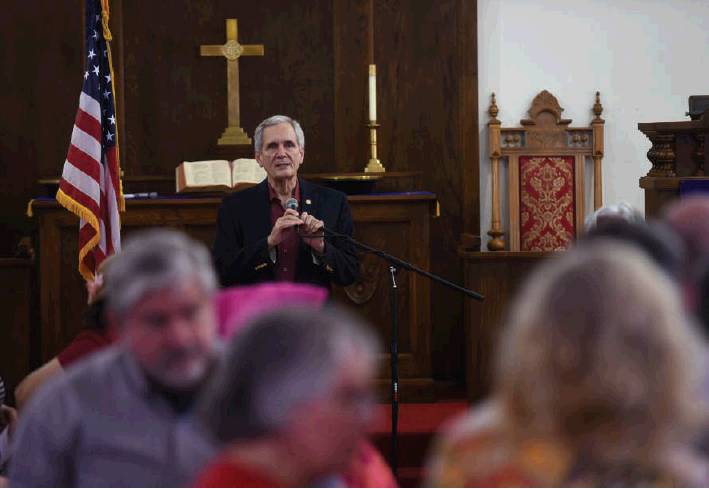
Billy Calzada / San Antonio Express-News
Meanwhile the collapse of the Republican health care bill now imperils the rest of President Donald Trump's ambitious congressional agenda.
The Washington Post reported Saturday that congressional Republicans have few prospects for quick victory on tax revisions, construction projects or a host of other issues in the months ahead despite complete GOP control of government.
While Republicans broadly share the goal of Trump's promised "big tax cuts," the president will have to bridge many of the same divides within his own party that sank the attempted overhaul of the ACA.
And without savings anticipated from the health care bill, paying for the "massive" cuts Trump has promised for corporations and middle-class families becomes considerably more complicated.
Meanwhile, other marquee agenda items, including a $1 trillion investment in roads and other infrastructure and proposed crackdowns on both legal and illegal immigration, will require the support of Democrats, many of whom have been alienated by the highly partisan start to Trump's tenure.
The lone exception for near-term victory could come with the confirmation of Supreme Court nominee Neil Gorsuch — but even that faces the prospect of a threatened filibuster by Democrats.
Trump and Republican leaders continued Saturday in their attempts to put a brave face on the health care debacle.
"ObamaCare will explode and we will all get together and piece together a great healthcare plan for THE PEOPLE," Trump wrote in a morning tweet. "Do not worry!"
But others in the party acknowledged the political damage sustained by pulling the House bill, particularly for a president who had touted his own deal-making prowess.
"It's a momentum issue," said Rep. Mike Coffman, R-Colo. "The fact is that, you know, you came out of the gate and you stumbled."
In San Antonio on Saturday at Doggett's town hall meeting, Kate Mathis, 62, from Churchill Estates asked how she could help change the, as she sees it, the narrative that Obamacare is "imploding."
"I've been a happy beneficiary of the ACA for three year," Mathis said. "I'm sick of hearing what the other side says when it's not true."
Doggett said the best way to change the narrative is to tell personal stories and vote.
"Everyone who says it's a failure and it's imploding, talk about how it helped someone you know — yourself or a family member or a neighbor and what a difference it made," he said.
Speaking to the Washington Post, Doug Heye, a GOP consultant and former congressional staffer, said Republicans, having achieved control of both chambers of Congress and the White House, were left with a lot to prove.
"It sends a troubling sign to a lot of folks about the broader issue of whether Republicans will be able to govern," he said.
Trump has said he would have preferred to start his term by cutting taxes. Even before the health care bill was pulled Friday, the president already was starting to turn the page.
Determined to highlight other priorities, Trump staged two announcements in the White House meant to underscore his commitment to creating jobs: granting a construction permit for the Keystone XL pipeline and appearing with executives of a telecom giant as they pledged to hire thousands of new employees, although the company's plans had already been announced in October.
Separately, Treasury Secretary Steven Mnuchin said at an event Friday that he will push Congress to enact comprehensive tax revisions by its August recess, though he acknowledged that the timetable might slip.
The White House signaled Saturday that it was eager to move on. Trump's weekly address made no mention of the health care fight, instead focusing on his signing of legislation authorizing funding for NASA and his commitment to space exploration.
"We're going to roll our sleeves up, and we're going to cut taxes across the board for working families, small businesses and family farms," Vice President Mike Pence said Saturday at an appearance in Scott Depot, West Virginia.
A senior White House official, however, said it was unlikely that Trump would ramp up a major sales effort on retooling taxes immediately, given that his team had been planning on using the coming days to push for Senate action on the health care bill.
Trump's top advisers had envisioned a three-step legislative agenda this year, starting with scaling back President Barack Obama's signature domestic initiative. After that was complete, they wanted to move to a comprehensive overhaul of the tax code, followed by the creation of a $1 trillion infrastructure package.
The implosion of the health care effort complicates the tax overhaul both logistically and politically.
House Republican leaders had been counting on changes to the tax code included in the health care bill to make the task of paying for future tax cuts easier.
Americans for Tax Reform President Grover Norquist said the bloc of hard-line Republicans who helped stymie the health care overhaul were guilty of "ripping the lungs out of tax reform."
If they don't revisit the health care bill immediately, Norquist said, they will soon realize that "they didn't shoot and wound health care reform, they shot and killed permanent tax reform."
House Speaker Paul Ryan, R-Wis., acknowledged Friday that the health care defeat "does make tax reform more difficult, but it does not make it impossible."
"We are going to proceed with tax reform," Ryan said.
Hours before the health bill was pulled, Mnuchin said a "comprehensive" overhaul of the tax code should prove less complex.
"Health care is a very, very complicated issue," he said at a Friday event hosted by Axios. "In a way, (tax reform is) a lot simpler. It really is."
Trump has proposed cutting the corporate tax rate from 35 percent to 15 percent, though many Republicans on Capitol Hill have been aiming for a 20 percent rate.
Trump has also proposed consolidating the existing seven individual income-tax brackets into three brackets of 10 percent, 20 percent and 25 percent.
Trump's advisers have argued that these changes would trigger a big expansion of economic growth, but some budget analysts have said the changes would widen deficits by anywhere from $2.6 trillion to $7 trillion over 10 years.
Many Republicans long have vowed that an overhaul of the tax code must be "revenue neutral," which means they need to find new revenue to offset the reduction in rates. Trump's advisers have not identified specific tax breaks they would eliminate to raise new revenue, and Trump himself often waved away debt concerns during the campaign.
Meanwhile, House and Senate Republicans are at odds over the wisdom of a key component of tax restructuring.
Ryan has proposed a border-adjustment tax that essentially would create new taxes on items imported into the United States as a way to raise close to $1 trillion in new revenue while also providing incentives for companies to move operations to the United States.
Many other Republicans oppose this idea, though, and the fight probably only will intensify now. Some Republicans, including Sen. Lindsey Graham, S.C., argue that the scheme would drive up prices on consumer goods, and many large retailers are strongly opposed.
Given such divides, as well as the mechanics of the budget process, it's highly unlikely that lawmakers will produce a comprehensive tax bill by the August recess, if at all, said Jim Manley, a former longtime aide to former Senate Majority Leader Harry Reid, D-Nev.
"It's clearly not realistic, and it's not going to happen, on policy and political grounds," Manley said, adding that the Republican agenda is also undercut by "a president who's out of his league and doesn't know how to legislate."
Republicans had planned to use a budget procedure called "reconciliation" for both the health-care overhaul and for the tax changes, as that would allow them to pass their plans with a simple majority in the Senate and make it impossible for Democrats to filibuster.
That's still the plan with a tax overhaul.
Barry Bennett, an adviser to Trump during the general election, said he thought it was a "tactical mistake" for the president not to have started his term by pushing for tax changes.
"Now you're going to have to carry these battle scars into the tax debate," he said.
Former House Speaker Newt Gingrich, who was a close adviser to Trump during the campaign, said the White House should postpone what is expected to be a messy battle over the tax code and instead pivot toward trying to build a large infrastructure package. Proceeding with infrastructure could attract bipartisan support, he said.
Some Democrats and labor unions have said they could support a big infrastructure package, though the White House has not specified how it plans to finance a package that includes roads, bridges, airports and broadband capability, among other things.
Mnuchin said Friday that the package probably would include several hundred billion dollars in public money but that the rest would be financed by the private sector, with public support as incentives. Democrats are wary of that approach and prefer more direct government spending.
Many Democrats and Republicans have tried — but failed — to pull off tax revisions in recent years. A principal reason changing the tax code is so difficult is because interest groups flood Washington looking for tax cuts but fight vigorously against any measure that would increase their bills.
"It's very, very hard to get done," said Doug Holtz-Eakin, a former director of the Congressional Budget Office who served as economic adviser to Sen. John McCain, R-Ariz., when he ran for president in 2008. "There are tons of different interests involved, and there are very different views within the Republican Party. Now you are going to enter into a second exercise of that type where you have clear evidence that holdouts can kill it. That empowers the holdouts."
Gingrich said the White House could learn some lessons from the failed House healthcare effort and change its approach going forward.
"I hope (Trump is) going to decide that he has to have a much more hands-on approach to drafting these things and can't just assume that it's going to show up," Gingrich said.
Washington Post writers John Wagner, Damian Paletta and Sean Sullivans contributed to this report.