Alcalde: UT Alumni Advocate for Higher Ed at Fourth Annual Longhorns on the Hill
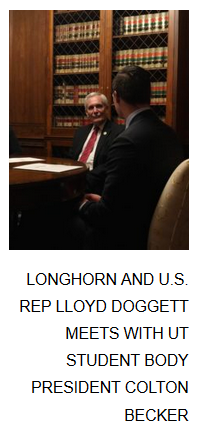
Around nearly every corner of the bustling U.S. House of Representatives on Wednesday, Sept. 5, from the Rayburn building to Longworth, you could spot burnt orange. For the fourth-annual Longhorns on the Hill, UT President Greg Fenves, Texas Exes Executive Director Chuck Harris, BBA '86, Life Member, and small groups of Texas Exes advocates spent a full day day speed-walking through the halls of the Capitol, darting between 30 meetings held with members of the Texas delegation. Whether through a lengthy sit-down around a long table in a congressional office, a hallway chat, or even an impromptu mid-committee hearing meeting with Rep. Lloyd Doggett, BBA '67, JD '70, Life Member, UT alumni made their voices heard about the value of higher education.
"It's important to be loud not just on gameday," says Debra McKeown, BJ '86, Life Member, who has attended Longhorns on the Hill every year since it began in 2015. "Having worked on the Hill myself, I understand that members and their staff have a tremendous amount of issues demanding their focus. We need to help them understand how they can help UT continue its mission to be a university of the first class."
One way advocates feel that legislators can help further that mission? By increasing federal dollars for research at public universities. Research from UT Austin brings in more than $724 million to the Texas economy. And, as Fenves told a full house at the Longhorns on the Hill Congressional Breakfast Wednesday morning, that research—like the MassSpec Pen, a breakthrough device that can detect cancerous tissue in real time—is changing the world.
And yet, funding for higher education continues to decline. In 2013, UT Austin received around 73 percent of its research funding from federal sources—by 2015, only 56 percent of research funding came from federal sources. At Longhorns on the Hill, advocates specifically asked lawmakers to increase money to federal agencies like the National Science Foundation (NSF)—who announced in August a grant that will position UT to have the fastest supercomputer at any U.S. university and pave the way for important discoveries in all fields of science—and the National Institutes of Health, whose funding made the MassSpec Pen a reality.